


Ordering custom outdoor window awnings that Melbourne homeowners can rely on starts with getting the measurements right. Whether you are replacing an old awning or improving shade around your home, accurate dimensions help you choose a suitable product and avoid preventable ordering problems.
The good news? You can prepare your measurements at home with a metal tape measure, a notepad, and a little patience. The important part is understanding which dimensions your chosen awning requires and how they relate to the mounting position. This guide explains exactly how to prepare your measurements, what to check before ordering, and when to ask for help.
What Do You Need Before Measuring Window Awnings?
Before measuring your window awnings, gather the following equipment and information:
- A rigid metal tape measure marked in millimetres.
- A notebook, phone or printable measurement worksheet.
- A pencil and a second person to help with wider windows.
- A step ladder only if it can be positioned safely on stable ground.
- A clear view of the window, surrounding wall and potential mounting area.
- The measurement instructions for the exact awning model you intend to order.
Measure in millimetres rather than switching between metres, centimetres and millimetres. Consistent units make it easier to record dimensions accurately and enter them into an online product form.
Important: A window opening measurement is not the same as the finished awning size. Some products require the overall fitting width, while others use different reference points. So, follow the instructions for the specific product before entering any dimensions.
How to Measure Outdoor Window Awnings Step by Step
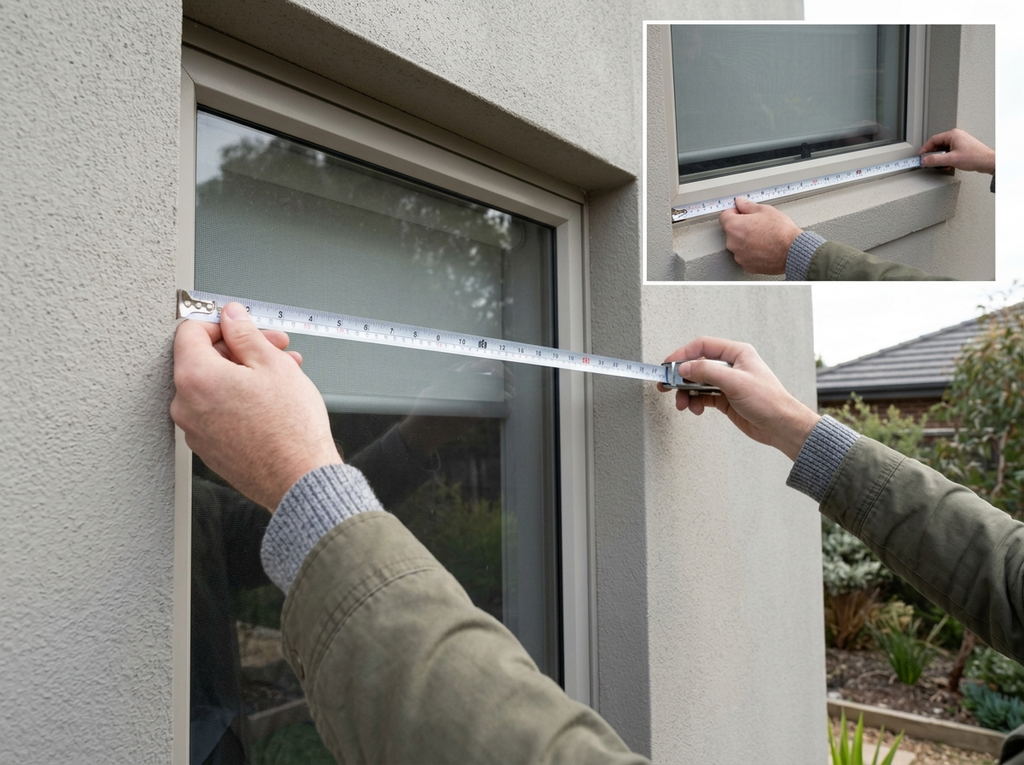
Step 1: Identify the correct window awning product
Start by confirming that you need a window awning rather than an outdoor blind designed to enclose a patio or alfresco area.
Window awnings are generally used to shade individual windows or doors. Folding arm awnings are commonly selected for wider outdoor areas, while Ziptrak-style systems and eZip blinds are designed for different outdoor screening applications.
If you are comparing outdoor awnings Melbourne suppliers, check the intended application before measuring. The measurement process for one product category may not apply to another.
Step 2: Inspect the window and mounting area
Look at the whole area where the awning is intended to sit. Identify the window frame, any architraves, eaves, gutters, external lights, pipes and other features that could affect placement.
Check whether the surface appears level and sound. Brick, rendered masonry, timber and other exterior surfaces may require different fixing methods. A visual inspection alone cannot confirm that a surface is structurally suitable for an awning.
If the wall is uneven, the window is unusually shaped, or the proposed fixing area is unclear, take photographs and seek advice before ordering.
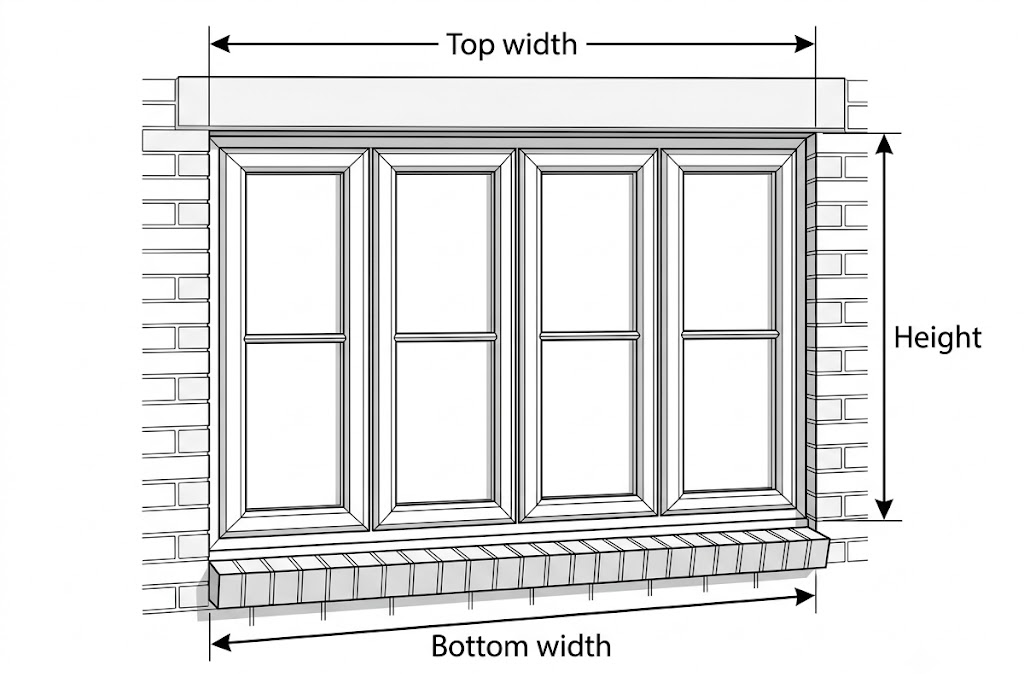
Step 3: Measure the top width
Measure the top width required by your chosen awning’s instructions. Use the specified reference points rather than automatically measuring only the glass or the visible window opening.
Record the measurement in millimetres and label it clearly as top width.
For example, your worksheet might show:
- Window reference: Front bedroom
- Top width: 1,500 mm
- Measurement reference: To be confirmed against product instructions
Note: This is an illustrative example, not a recommended awning size or a measurement to copy for your own window.
Step 4: Measure the bottom width
Where the product requires both top and bottom widths, measure the bottom using the same reference convention specified for that product.
Record it separately because the top and bottom may not be identical, particularly if the opening, surrounding trim, or wall is uneven.
If the two measurements differ, do not automatically average them or choose the smaller number. The correct dimension depends on the product’s design and installation requirements. However, you may ask the suppliers to confirm which measurements should be entered before submitting your order.
Step 5: Measure the height
Measure the height or drop using the reference points required by the product instructions. Record the result as height and note exactly where you measured from and to.
Check that the proposed awning position does not conflict with gutters, window operation, doors, or other nearby features. Also, do not add extra height to compensate for an uncertain measurement and do not subtract space for brackets or hardware unless the product instructions specifically tell you to do so.
Step 6: Repeat and record the measurements
Repeat each measurement carefully. Compare your notes with the measurements on the window, and check that you have not confused the top width, bottom width, and height.
For multiple windows, label each opening individually. Two windows that look similar may have different dimensions or mounting conditions. A photograph of each window, paired with its written measurements, can also help you a lot when asking for advice.
Window Awning Measurement Checklist
Use this checklist before placing an order for outdoor window awnings.
- Product confirmed: I have selected the correct window awning model.
- Top width recorded: I used the reference points specified for the product.
- Bottom width recorded: I measured and recorded it separately where required.
- Height recorded: I followed the product’s height or drop instructions.
- Units consistent: All measurements are recorded in millimetres.
- Measurements rechecked: I repeated the measurements and compared my notes.
- Obstructions identified: I checked gutters, eaves, lights, pipes, and window operation.
- Mounting surface considered: I have identified any concerns about the wall or fixing area.
- Product limits checked: The proposed dimensions and area are within the published limits, subject to product-specific confirmation.
- Uncertainties resolved: I have contacted the supplier if the measurements or installation conditions are unclear.
Quick answer: Accurate window awning measurements require the correct product-specific reference points, separately recorded dimensions where requested, consistent units, and a final check against the supplier’s sizing and installation instructions.
Common Window Awning Measuring Mistakes to Avoid
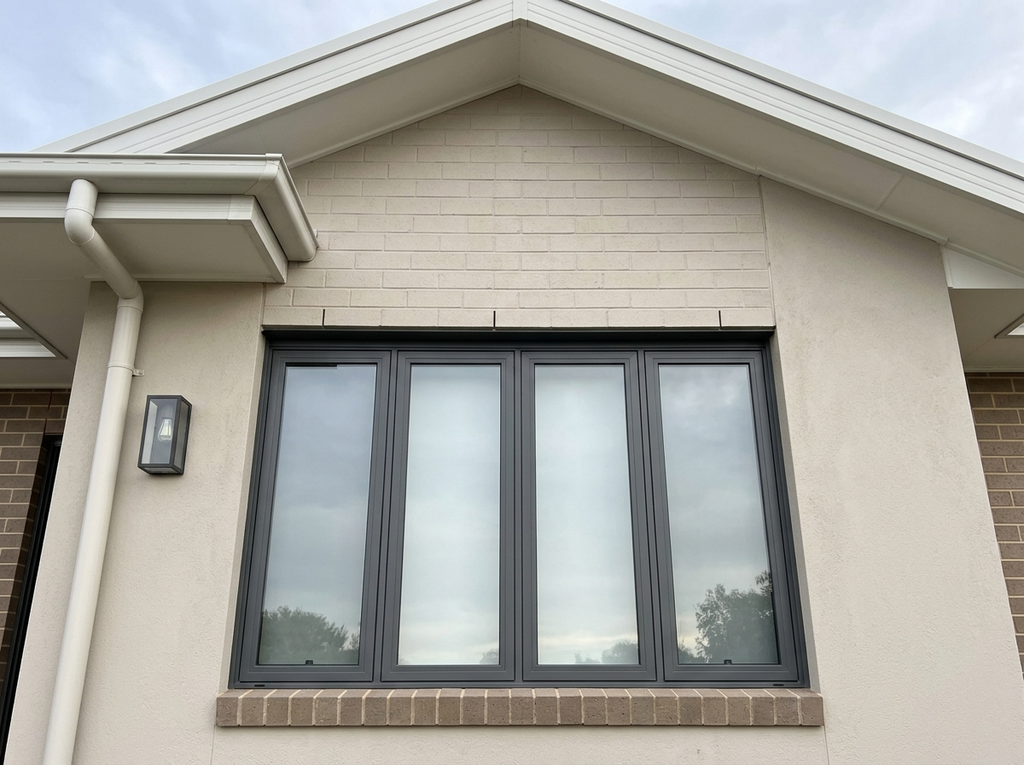
Measuring only the glass
The glass may not be the correct reference point for your awning. Follow the product instructions to establish the appropriate measurement points.
Assuming every window is square
Older homes and renovated properties can have uneven openings, irregular trim, or non-level surfaces. Record discrepancies rather than forcing measurements to match.
Guessing the mounting position
The awning’s fixing location affects its placement and the dimensions required. Do not finalise an order until you understand the product’s measurement convention.
Copying instructions for another blind
Measurement rules for internal roller blinds, external window awnings, folding arm awnings and Ziptrak patio blinds are not interchangeable. Use the instructions for the exact product being purchased.
Ignoring obstructions
Gutters, eaves, pipes, lights, and opening windows can affect the available space. Identify these before committing to dimensions.
Rushing a measurement
A single transposed digit can turn an otherwise accurate measurement into an incorrect order. Read each figure back, check the units, and compare the recorded result with your original measurement.
Should You Measure DIY Window Awnings Yourself?
You may be comfortable preparing the measurements yourself if the window is accessible, the reference points are clear, and you can safely inspect the proposed installation area.
However, DIY measuring may not be the right choice for every situation. Difficult access, uneven surfaces, uncertain mounting points, and dimensions near product limits are some of the major reasons to seek help.
So, if you are unsure about the measurement method, ask the supplier to confirm the required dimensions before you place your order. For concerns about structural fixing or safe access, consult a suitably qualified professional.
Window Awnings vs External Blinds: Does the Measurement Method Change?
Yes. Different products have different measurement requirements, so you should never transfer dimensions from one product category to another without checking its instructions.
| Product | Typical application | What to confirm before measuring |
| Window awnings | Individual windows and doors | Required width, height and mounting reference points |
| Folding arm awnings | Patios, decks and wider outdoor spaces | Required span, projection and fixing requirements |
| External roller blinds | Windows or outdoor openings | Product-specific width, drop and mounting method |
| Ziptrak outdoor blinds | Guided screening for patios and openings | Track positions, opening dimensions and installation clearances |
| eZip blinds | Outdoor screening applications | Exact product dimensions and hardware requirements |
If your goal is to shade one bedroom or living-room window, a window awning may be the relevant product to investigate. If you want to enclose an alfresco area, a patio blind may be more appropriate.
For a broader patio enclosure comparison, explore this relevant outdoor awnings and shading guide. However, confirm the specific product’s features and sizing requirements before deciding.
How Can Window Awnings Help With Melbourne’s Sun?
External shading can help prevent direct sunlight from reaching the glass, but the result depends on the window’s orientation, the awning’s design and the conditions at the property.
Sustainability Victoria explains that west-facing windows can receive significant afternoon sun and that adjustable external shading can help manage heat gain. Its guidance also highlights the importance of window orientation and seasonal sun angles.
So, when choosing outdoor window awnings in Melbourne, consider which room needs shade, when the sun enters, and whether you want adjustable shading. These considerations will help you select a suitable product, though they do not replace accurate measurement or a site-specific installation assessment.
Frequently Asked Questions
Ready to Check Your Window Awning Measurements?
Accurate measurements are the first step towards choosing the right awning for your home. Take your time, record each dimension clearly, and check the requirements for your selected product before ordering.
If you are ready to explore different options, visit DIY Blinds’ window awnings range. Also, DIY Blinds offers an optional check-measure service for window awnings at a small additional cost. So, you may review this option as well for further clarification.